Journal of Marine Sciences and Technology for Sustainable Development

Journal of Marine Sciences and Technology for Sustainable Development

Investigation of the Seismicity of the Makran Subduction Zone and the Probability of Tsunami Occurrence

Document Type : Original Article

Authors
1 Education and Training Center, Chabahar Free Zone, Chabahar, Iran
2 Department of Oceanography, Faculty of Marine Science, Chabahar Maritime University, Chabahar, Iran
Abstract
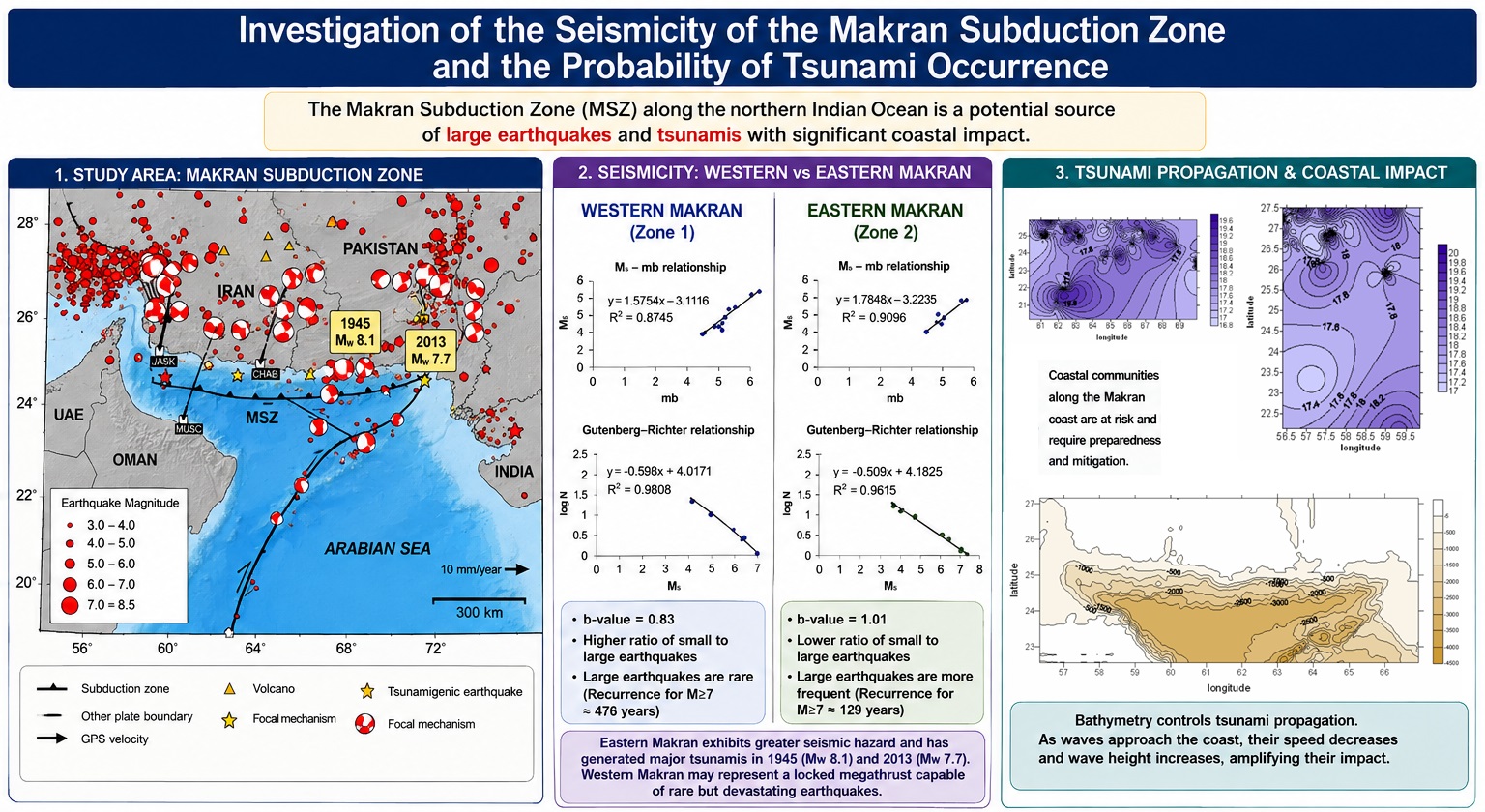
The north-dipping subduction of the Arabian Plate beneath the Central Iran and Afghan blocks formed the MSZ during the Cretaceous and continues today. This subduction, combined with the northward plate motion and resulting compressive stress, drives earthquakes and tsunamis in the northern Indian Ocean and along the Makran coasts in Iran and Pakistan. GPS data indicate that convergence rates increase from 35.5 to 36.5 mm/year in western Makran to 40 to 42 mm/year in the east, resulting in distinct seismic patterns in the region. Based on seismic data and the seismic hazard map of the Makran coast, the tectonic coefficient in Western Makran is higher than in Eastern Makran, indicating a higher ratio of small to large earthquakes in the west. While Western Makran experiences more small earthquakes, large earthquakes are less frequent. In contrast, Eastern Makran exhibits a lower ratio of small-to-large earthquakes. Overall, seismic hazard is more pronounced in Eastern Makran due to the concentration of seismic activity, consistent with the region’s fault movement. The most recent major tsunami, on 28 November 1945, followed an 8.1 magnitude earthquake in eastern Makran, killing at least 4,000 people. This spatial variation in seismicity may reflect segmentation of the subduction zone or a locked plate boundary in the east, which generates great earthquakes with long recurrence intervals.

Graphical Abstract

Investigation of the Seismicity of the Makran Subduction Zone and the Probability of Tsunami Occurrence
Keywords
Subjects

Volume 1, Issue 1
Section A: Engineering and Technologies
June 2026

  • Receive Date 23 February 2026
  • Revise Date 15 March 2026
  • Accept Date 05 April 2026
  • First Publish Date 01 June 2026
  • Publish Date 01 June 2026